
alking about “this one exactly” is also called “definite reference.” We use it when both the reader and the writer can identify the exact noun that is being referred to. When you mean “this one exactly,” you have two article choices: Ø, the. The choice of article depends on the noun and on the context. Ask yourself, “What kind of noun is it?”
(Most) Proper nouns = no article (Ø)
- My research will be conducted in Luxembourg.
- Dr. Homer inspired my interest in Ontario.
Note: Some proper nouns do require “the.” See the special notes on nouns below.
Non-count nouns = the
- Step two: mix the water with the boric acid.
- The laughter of my children is contagious.
Plural nouns = the
- We recruited the nurses from General Hospital.
- The projects described in your proposal will be fully funded.
Singular nouns = the
- Bring the umbrella in my closet if it looks like rain.
- Did you get the visa you applied for?
In certain situations, we always use “the” because the noun or the context makes it clear that we’re talking about “this one exactly.” The context might include the words surrounding the noun or the context of knowledge that people share. Examples of these situations include:
Unique nouns
- The earth rotates around the sun.
- The future looks bright!
Shared knowledge (both participants know what’s being referred to, so it’s not necessary to specify with any more details)
- The boss just asked about the report.
- Meet me in the parking lot after the show.
Second mention (with explicit first mention)
- I found a good handout on English articles. The handout is available online.
- You can get a giant ice cream cone downtown. If you can eat the cone in five seconds, you get another one free.
Second mention (with implied first mention—this one is very, very common)
- Dr. Frankenstein performed a complicated surgery. He said the patient is recovering nicely. (“The patient” is implied by “surgery”—every surgery has a patient.)
- My new shredder works fabulously! The paper is completely destroyed. (Again, “the paper” is implied by “shredder.”)
Ordinals and superlatives (first, next, primary, most, best, least, etc.)
- The first man to set foot on the moon…
- The greatest advances in medicine…
Specifiers (sole, only, principle, etc.)
- The sole purpose of our organization is…
- The only fact we need to consider is…
Restricters (words, phrases, or clauses that restrict the noun to one definite meaning)
- Study the chapter on osmosis for the test tomorrow.
- Also study the notes you took at the lecture that Dr. Science gave yesterday.
Plural nouns in partitive -of phrases (phrases that indicate parts of a larger whole) (Note: Treat “of the” as a chunk in these phrases—both words in or both words out)
- Most of the international students have met their advisors, but a few of them have appointments next week. (emphasis on part of the group, and more definite reference to a specific group of international students, like the international students at UNC)
- Most international students take advantage of academic advising during their college careers. (emphasis on the group as a whole, and more generic reference to international students everywhere)
- Several of the risk factors should be considered carefully, but the others are only minor concerns. (emphasis on part of the group)
- Several risk factors need to be considered carefully before we proceed with the project. (emphasis on the group as a whole)
- A few of the examples were hard to understand, but the others were very clear. (emphasis on part of the group)
- A few examples may help illustrate the situation clearly. (emphasis on the group as a whole)
Note: “Few examples” is different from “a few examples.” Compare:
- The teacher gave a few good examples. (a = emphasizes the presence of good examples)
- The teacher gave few good examples. (no article = emphasizes the lack of good examples)
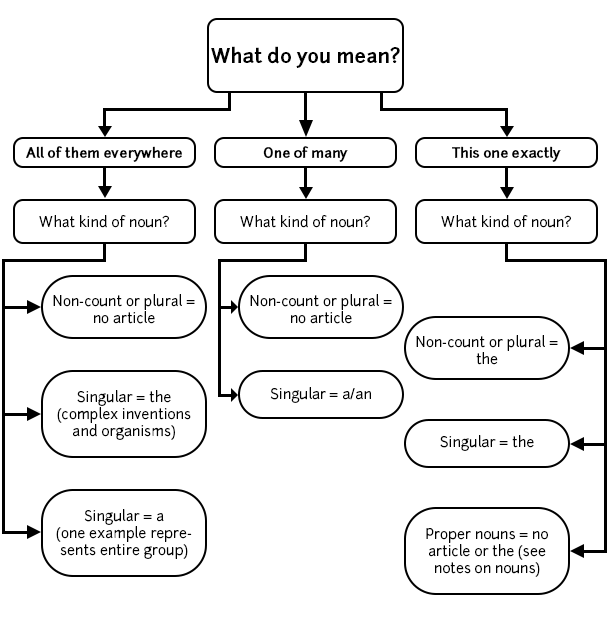
Article flowchart
For the more visually oriented, this flowchart sketches out the basic rules and basic questions.
Some notes about nouns
Uncountable nouns
As the name suggests, uncountable nouns (also called non-count or mass nouns) are things that can not be counted. They use no article for generic and indefinite reference, and use “the” for definite reference. Uncountable nouns fall into several categories:
- Abstractions: laughter, information, beauty, love, work, knowledge
- Fields of study: biology, medicine, history, civics, politics (some end in -s but are non-count)
- Recreational activities: football, camping, soccer, dancing (these words often end in -ing)
- Natural phenomena: weather, rain, sunshine, fog, snow (but events are countable: a hurricane, a blizzard, a tornado)
- Whole groups of similar/identical objects: furniture, luggage, food, money, cash, clothes
- Liquids, gases, solids, and minerals: water, air, gasoline, coffee, wood, iron, lead, boric acid
- Powders and granules: rice, sand, dust, calcium carbonate
- Diseases: cancer, diabetes, schizophrenia (but traumas are countable: a stroke, a heart attack, etc.)
Note: Different languages might classify nouns differently
- “Research” and “information” are good examples of nouns that are non-count in American English but countable in other languages and other varieties of English.
Strategy: Check a dictionary. A learner’s dictionary will indicate whether the noun is countable or not. A regular dictionary will give a plural form if the noun is countable. Note: Some nouns have both count and non-count meanings Some nouns have both count and non-count meanings in everyday usage. Some non-count nouns have count meanings only for specialists in a particular field who consider distinct varieties of something that an average person would not differentiate. Non-count meanings follow the rules for non-count nouns (generic and indefinite reference: no article; definite: “the”); count meanings follow the count rules (a/an for singular, no article for plural). Can you see the difference between these examples?
- John’s performance on all three exams was exceptional.
- John’s performances of Shakespeare were exceptional.
- To be well educated, you need good instruction.
- To assemble a complicated machine, you need good instructions.
Proper nouns
Proper nouns (names of people, places, religions, languages, etc.) are always definite. They take either “the” or no article. Use “the” for regions (like the Arctic) and for a place that’s made up of a collection of smaller parts (like a collection of islands, mountains, lakes, etc.). Examples:
- Places (singular, no article): Lake Erie, Paris, Zimbabwe, Mount Rushmore
- Places (collective, regional, “the”): the Great Lakes, the Middle East, the Caribbean
Note: Proper nouns in theory names may or may not take articles When a person’s name is part of a theory, device, principle, law, etc., use “the” when the name does not have a possessive apostrophe. Do not use “the” when the name has an apostrophe. Examples:
| the Doppler effect | Einstein’s theory of relativity |
| the Pareto index | Murphy’s law |
| the Reimann hypothesis | Halley’s comet |
Note: Articles change when proper nouns function as adjectives Notice how the article changes with “Great Lakes” in the examples below. When place names are used as adjectives, follow the article rule for the noun they are modifying. Examples: I’m studying …
- …the Great Lakes. (as noun)
- …a Great Lakes shipwreck.(as adjective with “one of many” singular noun)
- …the newest Great Lakes museum. (as adjective with “this one exactly” singular noun)
- …Great Lakes shipping policies. (as adjective with “one of many” plural noun)
- …Great Lakes history. (as adjective with “one of many” uncountable noun)